


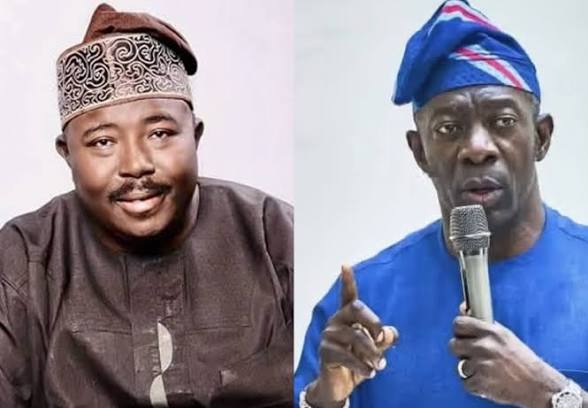
Senator Sharafadeen Alli has promised to increase Oyo State’s Internally Generated Revenue (IGR) to ₦150 billion. Yet, he has not presented the data, assumptions, economic modelling, or implementation framework required to make such a promise credible.
That is a serious omission because a number is not a strategy, a promise is not a plan, and a target is not an achievement.
Governance is not conducted on the basis of hope, guesswork, or campaign rhetoric. It is built on evidence, planning, and execution. When a candidate promises to generate an additional ₦50 billion annually above current revenue levels, the people deserve more than a headline figure. They deserve to see the mathematics behind the promise.
Until Senator Alli provides the facts, figures, and roadmap supporting his ₦150 billion projection, the people of Oyo State are entitled to ask a simple question: Is this a serious economic plan or merely a campaign slogan wrapped around an attractive number? More importantly, is it a subtle warning of a man who intends to achieve its target through new taxes and levies on the people?
The gubernatorial candidate of the Allied People’s Movement (APM), Honourable Bimbo Adekanmbi, has therefore challenged Senator Alli to explain how he intends to increase Oyo State’s IGR to ₦150 billion without imposing additional taxes and levies on citizens and businesses.
Adekanmbi, a Chartered Accountant and Fellow of the Association of Chartered Certified Accountants (FCCA), noted that growing government revenue should not automatically translate into heavier burdens on taxpayers.
Rather, sustainable revenue growth should come from expanding economic activity, widening the tax net, improving compliance, and plugging leakages within the system.
He pointed out that this was essentially the approach adopted by the administration of Governor ‘Seyi Makinde.
When Governor Makinde assumed office in 2019, Oyo State generated approximately ₦1.7 billion in monthly IGR. Today, the state generates about ₦8.7 billion monthly, representing more than a fivefold increase in revenue.
This growth was driven by deliberate reforms, improved revenue administration, investment promotion, technological innovation, economic expansion, and the elimination of leakages in the revenue collection system.
The growth has also been consistent and measurable in recent years. Oyo State’s Internally Generated Revenue increased from ₦51.25 billion in 2023 to ₦65.29 billion in 2024, representing a 27.4 per cent increase within one year.
In 2025, the state crossed the historic ₦100 billion annual IGR milestone, generating ₦103.2 billion, an increase of more than 101 per cent over the 2023 figure.
The momentum has continued into 2026. In the first six months of the year alone, the state generated ₦55.3 billion, putting it firmly on course to achieve its projected ₦110 billion annual IGR target.
These figures did not emerge from wishful thinking or political slogans. They are the product of deliberate policies, strategic planning, sustained reforms, and disciplined execution.
More importantly, this transformation was achieved without imposing new taxes and punitive levies on traders, artisans, transport operators, market women, small business owners, and other hardworking citizens.
Today, Oyo State generates more than ₦100 billion annually in IGR. Senator Alli now proposes to increase that figure to ₦150 billion, effectively promising to generate almost ₦50 billion in additional revenue every year.
That is not a marginal increase.
That is not a statistical adjustment.
That is a major revenue leap.
And that is precisely why the people deserve answers.
Where will the additional almost ₦50 billion come from?
What sectors of the economy will generate it?
What new economic activities have been identified to support such growth?
What investment opportunities will unlock this revenue?
What revenue leakages remain undiscovered after seven years of sustained reforms?
What evidence, projections, and economic assumptions support the ₦150 billion target?
Most importantly, can Senator Alli guarantee that achieving this target will not result in new taxes, levies, fees, permits, and charges for already struggling citizens and businesses?
These are not partisan questions; they are questions of accountability.
If Senator Alli believes the additional revenue will come from economic growth, he should identify the sectors and provide the projections.
If he believes it will come from investment, he should identify the investments and expected returns.
If he believes it will come from improved collection efficiency, he should explain what leakages remain and how much they are worth.
If he cannot do any of these things, then the public is entitled to wonder whether the ₦150 billion target was arrived at through rigorous economic analysis or mere political calculation.
The contrast is clear.
The Makinde administration can point to a measurable record. It inherited an Oyo State generating about ₦1.7 billion monthly and increased that figure to approximately ₦8.7 billion monthly through deliberate reforms and sound economic management.
This is a model of responsible revenue growth that Honourable Bimbo Adekanmbi is committed to sustaining and improving upon as Governor of Oyo State.
Senator Alli, on the other hand, is asking the people to trust a projection that is yet to be backed by publicly available data or a verifiable implementation plan.
Oyo people are not asking for promises; they are asking for proof. They want the numbers behind the numbers, the assumptions behind the projections, and the roadmap behind the rhetoric.
The issue is not whether ₦150 billion is an attractive figure. The issue is whether there is a credible plan behind it.
Senator Sharafadeen Alli’s failure to provide a credible roadmap for raising the state’s Internally Generated Revenue (IGR) from about ₦100 billion to ₦150 billion underscores what we have always said about his candidacy: it is rich in sensation but poor in substance. He has consistently failed to demonstrate the intellectual rigour and policy depth required for the office he seeks. That should concern every voter.
