







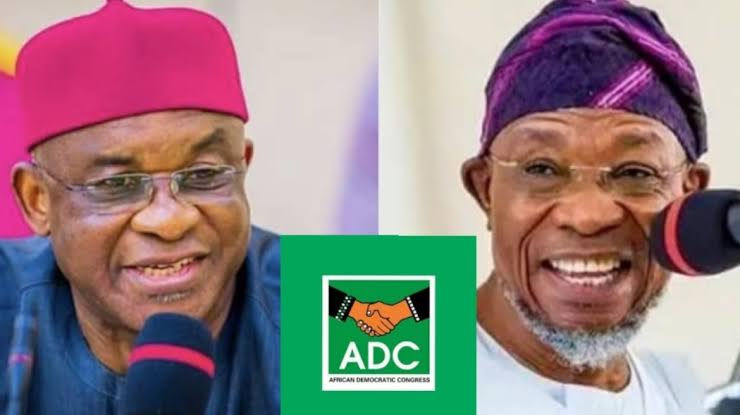



The internal crisis rocking the African Democratic Congress (ADC) has intensified, with a rival faction formally asking the Independent National Electoral Commission (INEC) to withdraw recognition of the party’s current leadership.

The faction, led by Nafiu Bala, is pushing to take control of the party and has called on INEC to remove former Senate President David Mark as National Chairman and ex-Osun State Governor Rauf Aregbesola as National Secretary.

Court rulings shape leadership tussle
The latest move follows a legal battle between both camps. Bala has consistently argued that he should assume the position of national chairman following the resignation of former party leader Ralph Nwosu.
Earlier, Justice Emeka Nwite of the Federal High Court in Abuja declined Bala’s request to immediately compel INEC to derecognise Mark and Aregbesola, instead asking both men to respond to the application.
Dissatisfied, Mark approached the Court of Appeal. However, the appellate court dismissed his appeal on procedural grounds, ruling that it was incompetent. The court, led by Justice Uchechukwu Onyemenam, further directed all parties to maintain the status quo pending the final determination of the substantive case at the Federal High Court.
Bala writes INEC, seeks recognition
Riding on the appellate court’s pronouncement, Bala—through his counsel, Robert Emukpoeruo (SAN)—has now written to INEC, urging the commission to stop recognising the Mark-led leadership.

In the letter dated March 16, Bala’s camp argued that the court’s directive to maintain the “status quo ante bellum” implies that any action taken after the disputed leadership changes should not stand.
He also appealed to party members nationwide to remain calm, law-abiding, and committed to the party’s ideals amid the ongoing dispute.
Counter-position warns INEC against action
In a counter move, another senior lawyer, Dr. Sulaimon Usman (SAN), has advised INEC to ignore Bala’s request. In his own letter to the commission, Usman stressed that it would be more appropriate for INEC to maintain neutrality until the court delivers a final judgment.
He noted that the current leadership structure of the party emerged from a National Executive Committee meeting monitored by INEC in July 2025 and remains valid until the court rules otherwise.
Allegations of political interference emerge
Meanwhile, the crisis has taken a political turn, with allegations from within the ADC that external forces are attempting to influence the situation.
A party stakeholder, Abdullahi, alleged that elements within the Presidency and the All Progressives Congress (APC) are pressuring INEC to weaken the ADC ahead of the 2027 general elections.
He claimed the alleged plan is to prevent the ADC from fielding a presidential candidate, thereby clearing the path for President Bola Tinubu to run without strong opposition.
APC dismisses claims as “baseless”
Reacting, APC National Secretary Ajibola Basiru dismissed the allegations, describing them as unfounded and a distraction from the ADC’s internal problems.
Basiru maintained that neither the Presidency nor the APC is involved in the party’s legal dispute, insisting that the matter remains strictly within the ADC and the courts.
He urged the opposition party to respect the Court of Appeal’s directive to maintain the status quo, adding that INEC must not be pressured into acting against a subsisting court order.
According to him, any party dissatisfied with the ruling should seek redress at the Supreme Court rather than making accusations.
Uncertain path ahead
With both legal and political tensions rising, the ADC’s leadership question remains unresolved. The final decision now rests with the Federal High Court, whose ruling is expected to determine the legitimate leadership of the party and shape its future ahead of the 2027 elections.


