







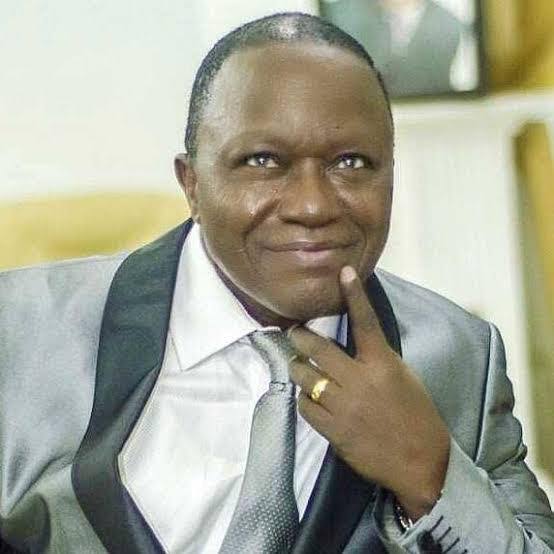




A respected legal voice in Ibadanland, Niyi Akintola, has come forward to clear the air over the recent elevation of three high chiefs to the status of beaded-crown Obas in Ibadanland, insisting that Governor Seyi Makinde acted strictly within the bounds of the law.


Speaking during a radio programme on Saturday, the Senior Advocate of Nigeria dismissed speculations that the decision to present Staff of Office to the new obas was irregular or politically driven.


Last Friday, the Oyo State Government formally elevated and presented Staff of Office to Sharafadeen Alli, the Ekarun Balogun of Ibadanland; Akeem Mobolaji Adewoyin, the Ekerin Balogun of Ibadanland; and Oyekola Babalola, SAN, the Ekarun Olubadan of Ibadanland, recognizing them as beaded-crown wearing obas.

The ceremony took place at the historic Mapo Hall, a venue deeply rooted in the political and cultural history of Ibadan. However, the absence of the newly elevated obas at the event stirred conversations in some quarters, with critics questioning the legitimacy of the exercise.

But Akintola insisted there was nothing unlawful about the development.

According to him, neither the Oyo State Government nor the Olubadan of Ibadanland, Rashidi Ladoja, acted outside the provisions of the amended chieftaincy law guiding the Ibadan traditional system.

He explained that the recent elevation is part of the broader reforms that have gradually codified the Ibadan traditional structure — a move he described as long overdue and widely desired by sons and daughters of the ancient city.
“The law has been amended and our tradition has now been clearly codified. There is absolutely nothing wrong with what was done,” Akintola said. “Everything that happened was within the ambit of the law. People simply need to take time to read and understand the provisions.”
The legal luminary also commended the roles played by the late former governor Abiola Ajimobi and Governor Makinde in strengthening the traditional institution in Ibadanland through legislative reforms.
According to him, the evolution of the system now means that Ibadan — a vast metropolis with more than 30 towns under its traditional structure — has multiple recognized obas who operate under the supreme authority of the Olubadan.
He noted that the arrangement does not in any way diminish the position of the Olubadan but rather enhances administrative coordination across the sprawling Ibadan territory.
Akintola further dismissed claims that the ceremony was politically motivated, explaining that the process leading to the elevation was triggered through legitimate traditional and administrative channels.
He revealed that the development followed a petition written by one of the affected chiefs regarding delays in the elevation process, after which the Olubadan communicated with the state government in line with the law.
On the controversy surrounding the absence of the newly elevated obas at the ceremony, Akintola maintained that their physical presence was not a legal requirement for the conferment of their new status.
“In any institution, including workplaces, promotion does not require you to be physically present before it takes effect,” he explained. “Once due process has been followed and it is your turn in the hierarchy, the elevation stands.”
He also clarified that the Olubadan was duly represented at the event, just as the governor was represented by the deputy governor, stressing that representation does not invalidate official proceedings.
Akintola concluded by urging residents to view the development within the broader context of Ibadan’s evolving traditional governance system, describing the reforms as part of a long-standing aspiration to strengthen leadership across the many communities that make up Ibadanland.
For him, the latest elevation is not a controversy but rather a continuation of a historical journey toward modernizing and properly structuring one of Nigeria’s most respected traditional institutions.


